

Are there any metals more expensive than gold? Surprisingly, although this iconic precious metal continues to rise in price, gold is not even among the three most valuable metals. Most people are unaware that the most expensive material in the world is artificially produced rather than naturally formed.
Today, the most valuable metal in the world is not gold, silver, or platinum, but californium, a little-known metal. Due to their high cost, rare precious metals are rarely traded on the open market. However, there are several other precious metals that you can easily buy on exchanges and profit from price fluctuations.
This article explains which metals are more expensive than gold and how you can make money from them.
What Makes a Metal More Valuable Than Gold?
Nội dung
Few people realize that, besides well-known metals such as gold and silver, there are many that are even more valuable. However, gold has consistently received attention over the years because it is considered a safe-haven asset.
If you look a little deeper, you will find that gold is not the most expensive metal. That title belongs to californium, a synthetic element that does not occur naturally on Earth and is estimated to be worth about 8,000 times more than gold.
Among naturally occurring metals, osmium-187 is the most expensive. It is rarely found in pure form, making it about 50 times more expensive than gold.

Where Are the Most Valuable Metals Mined?
Rare metals are typically not found in pure form and are usually extracted from mineral ores.

Open-pit mines in South Africa are famous for hosting some of the richest platinum-group metal deposits, including other platinum-group metals produced in limited quantities, significantly impacting global supply. The country accounts for up to 70% of global platinum production, 85% of global rhodium supply, and 80% of global iridium production.
Russia is one of the leading countries in terms of rare earth ore deposits. Platinum, palladium, iridium, rhodium, copper, gold, silver, and many other metals are mined there.
South America, the United States, and Australia are among the largest metal producers. Notably, californium-252 is synthesized in only two locations: Oak Ridge National Laboratory in the United States and the Research Institute of Atomic Reactors in Russia.
The Most Valuable Metals in the World
Currently, there are about 20 truly expensive and rare metals widely used in industry and science. When ranked by price, positions from fifth place downward change monthly. Below is a list of the 10 most expensive metals in the world today.
Californium
This most expensive metal on the planet was first discovered in 1950 at the University of California, Berkeley, and was named in honor of the university.
Today, the fastest way to synthesize californium is by producing it from curium. However, there is also a longer production method starting from plutonium. Using this method, about 10 kg of plutonium is required to extract just 1 milligram of californium-252.
The metal is so rare that scientists synthesize only about 10 milligrams per year, and so far only about 10 grams have ever been produced. Despite its rarity, californium is highly sought after worldwide and is used in medicine, geological exploration, nuclear energy, and artifact analysis.
The current value of californium is $27 million per gram.
Osmium
The most expensive naturally occurring element was identified by British chemist Smithson Tennant in 1805. Osmium is the densest naturally occurring element in the world, with a density of 22.61 g/cm³. This means that a cube of metal measuring 10 cm on each side would weigh more than 22 kg.
Osmium is extremely rare in the Earth’s crust, with an estimated concentration of only about 0.00005 parts per million (ppm). Only about 100–120 kg of this metal are produced annually. It does not occur in pure form in nature and is obtained as a by-product of platinum ore processing. Despite its scarcity, osmium remains in high demand and is used in the chemical industry, in the production of super-hard alloys, and in electronics and microelectronics.
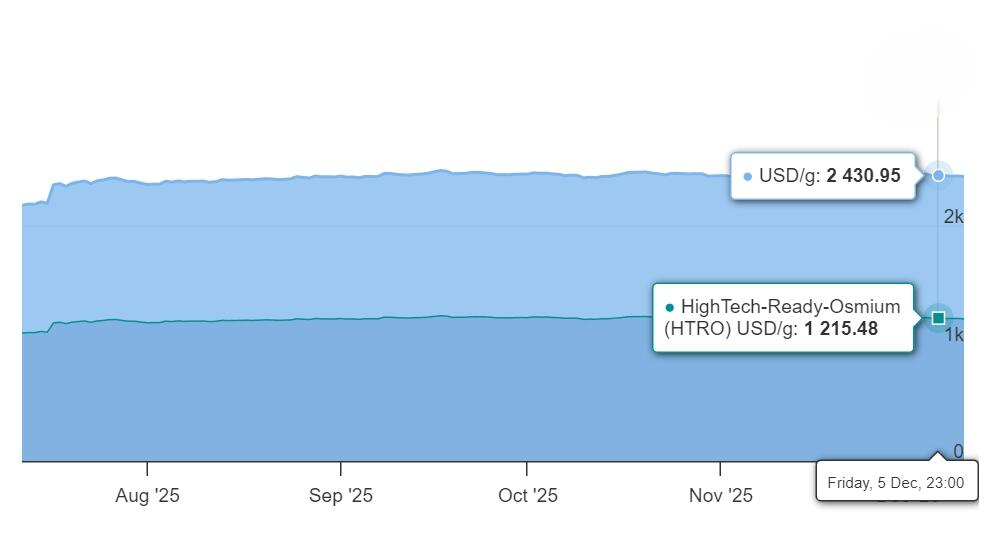
The current value of crystalline osmium is $2,400 per gram.
Rhodium
The most expensive jewelry metal was discovered by British chemist William Wollaston in 1803. Rhodium is an extremely hard element with a density of 12.4 g/cm³.
Today, the amount of rhodium in the Earth’s crust is estimated at only about 0.0002 ppm, and approximately 29–30 tons are mined annually. Rhodium is in high demand worldwide and is used in the automotive, electronics, and optical industries. It is also used for rhodium plating, where a thin layer of metal is applied to silver and silver-gold alloy jewelry to increase hardness and surface reflectivity. Currently, up to 80% of industrial rhodium is used in the production of catalytic converters for gasoline engines, helping prevent toxic emissions, including carbon monoxide and other combustion by-products.

The current price of rhodium is $8,000 per ounce.
Iridium
Iridium, one of the rarest natural metals on Earth, was discovered by British chemist Smithson Tennant in 1803. It has a density of 22.56 g/cm³, slightly lower than osmium.
Today, iridium’s concentration in the Earth’s crust is estimated at 0.001 ppm, with about 8 tons mined annually. The metal is used as an additive to strengthen alloys and in high-temperature applications such as spark plugs and crucibles. Iridium is applied in medical device manufacturing, automotive catalytic converters, and the aerospace industry. It is also widely used in jewelry.
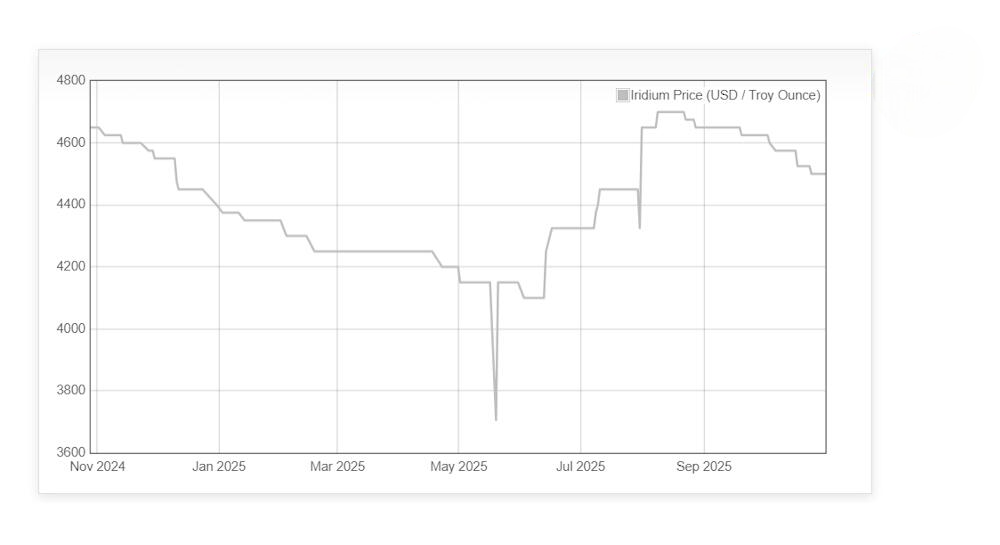
The current value of iridium is $4,500 per ounce.
Gold
The most famous precious metal in human history was discovered around 4000 BC in Mesopotamia and ancient Egypt. Gold is a naturally occurring soft but heavy element with a density of 19.32 g/cm³.
Today, gold reserves in the Earth are estimated at about 132,000 tons, and approximately 3,600 tons are mined annually. Gold is used in the jewelry industry, including white gold alloys for wedding rings, as well as in electronics, automotive, and aerospace industries. Furthermore, gold is one of the most actively traded commodities on stock exchanges, with daily trading volumes of around $200 billion globally.

The current price of gold is $4,599.37 per ounce.
Platinum
This precious metal was discovered in the 16th century in what is now Colombia. Platinum is one of the heaviest metals, with a density of 21.09 g/cm³, ranking just behind osmium and iridium.
Estimated reserves stand at 0.005 ppm, with about 170 tons mined annually. Platinum is used in jewelry, electronics, and the automotive industry. It also plays a crucial role in aerospace due to its durability and chemical stability.
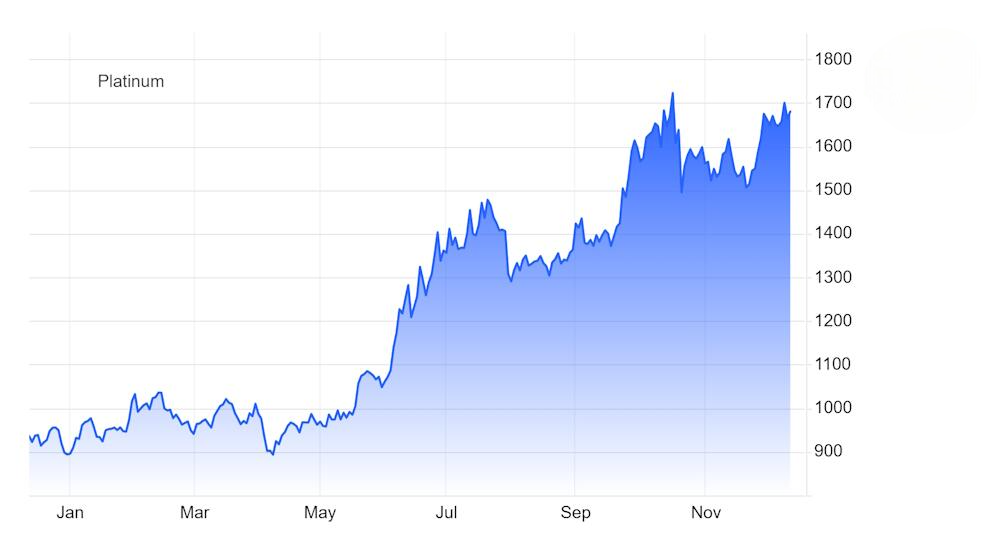
The current value of platinum is $2,378.43 per ounce.
Palladium
Palladium was discovered by British chemist William Hyde Wollaston in 1803. It is a relatively ductile metal with a density of 12.02 g/cm³. Palladium is valued for its reversible hydrogen absorption capability: at room temperature, one volume of palladium can absorb up to 800 volumes of hydrogen.
Today, palladium’s concentration in the Earth’s crust is estimated at 0.015 ppm, and about 190 tons are mined annually. Palladium is used in jewelry, electronics, automotive manufacturing, and dentistry.

The current value of palladium is $1,808.20 per ounce.
Ruthenium
Ruthenium was discovered by Carl Claus in 1844. It is a naturally occurring, malleable metal with a density of 12.45 g/cm³, slightly higher than platinum and palladium.
Currently, ruthenium’s concentration in the Earth’s crust is estimated at about 0.005 ppm, and it is mainly found in the mineral laurite. Only about 20 tons are mined annually. The metal is valued for its catalytic properties in industry: it is used in electrical contacts, as a catalyst in chemical reactions, and in the production of heat-resistant structures due to its very high melting point.

The current value of ruthenium is $1,038.74 per ounce.
Rhenium
This natural metal was discovered by German chemists Ida and Walter Noddack in 1925. Rhenium has a density of 21.02 g/cm³, close to that of iridium.
Today, rhenium’s concentration in the Earth’s crust is estimated at only about 0.07 ppb. About 60 tons are mined annually. Rhenium is used in the production of catalysts for the oil and gas industry, to strengthen nickel-based superalloys, and in the manufacture of molybdenum and tungsten alloys.
The current value of rhenium is $128.44 per ounce.
Silver
Silver was discovered in ancient Egypt around 5000 BC. It is a soft and relatively light metal, with a density of 10.5 g/cm³.
Currently, silver is found in the Earth’s crust at an average concentration of about 0.075 grams per ton, and approximately 22,000 tons are mined annually. Silver is used in jewelry, electronics, automotive manufacturing, and photography.

The current value of silver is $90.592 per ounce.

 VN
VN CN
CN
Why Did Metals Dominate All Asset Classes in 2025 (and What Does It Mean for 2026)?
The performance of gold and silver in 2025 was not only impressive by historical standards...
Mar
Gold Prices Head Toward $5,000, Silver Approaches $100
Precious Metals Approach Historic MilestonesNội dung1 Precious Metals Approach Historic Milestones1.1 Gold and Silver Returns...
Jan
Why Silver Is Still Far From the End of Its Bull Cycle
Silver has just crossed the $100 per ounce mark. Gold is approaching $5,000. And if...
Jan